

MACRO MORNING BRIEFING
Monday 28th April 2025
A LOOK BACK AT THE ECONOMIC DATA
[caption id="attachment_7593" align="alignnone" width="712"]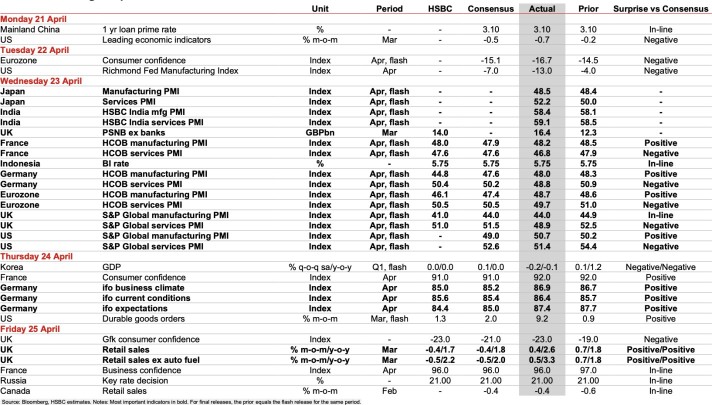 A LOOK BACK AT THE ECONOMIC DATA[/caption]
NEWS
ASIA: [%1 Day change: TOPXI +0.86% (2,650 pts), NIKKEI 225 +0.38% (35,839 pts), ASX 200 +0.36% (7,997pts), KOSPI +0.10% (2,548 pts), HANG SENG -0.04% (21,971 pts), CSI 300 -0.14% (3,781 pts), SHANGHAI COMP -0.20% (3,288 pts), SHENZHEN COMP -0.93% (1,897 pts)] Asian stock markets were mixed on Monday, as Japanese shares rose, boosted by Toyota’s surge on a potential buyout of its supplier, while Chinese stocks were subdued amid ongoing uncertainties surrounding U.S.-China trade talks. Cumulative profits of China’s industrial firms rose 0.8% to 1.5 trillion yuan ($205.86 billion) in the first quarter from a year earlier, reversing a 0.3% decline in the first two months. In March alone, profits rose 2.6% on-year. The profit gain in the first quarter followed a 3.3% fall in 2024, reversing the trend of continuous declines in cumulative profits of enterprises since the third quarter of last year, Yu Weining, an NBS statistician, said in a separate statement along with the data release.- China will likely lower reserve requirement ratio for banks and interest rates in the second quarter to support the economy and counter external shocks, Securities Daily reports, citing Time is ripe for the PBOC to cut RRR and interest rates in 2Q, given the changes in trade environment and trends in the property market and consumer prices, says Wang Qing, an analyst at Golden Rating Credit. China may cut interest rates by 0.3 percentage point and RRR by 0.5 percentage point, which will unleash 1 trillion yuan of long-term funds, Wang said.
- Chinese officials reiterated their plan to strengthen support for employment and the economy, as a trade war with the Trump administration continues with no immediate off-ramp in The government will “fully prepare contingency plans, and constantly improve the policy toolbox for stabilizing employment and the economy,” Zhao Chenxin, Vice Chairman of the National Development and Reform Commission, said in a Monday briefing.
- South Korea’s Industry Minister Ahn Duk-geun said on Saturday that Seoul plans to approach trade talks with the United States "calmly and " The negotiations were off to a good start but South Korea will closely monitor the progress in trade talks between the U.S. and other countries, Ahn told reporters after returning from Washington. "This (coming) week, working-level talks will kick off during which a specific working group will be confirmed," Ahn said.
US
Wall Street advanced on Friday, notching weekly gains as investors parsed a spate of earnings and looked for signs of easing tensions in the U.S.-China trade dispute. The S&P 500 and the Nasdaq were bolstered by gains in the "magnificent seven" group of artificial intelligence-related megacaps, while the blue-chip Dow was more muted. The Russell 2000 enjoyed its largest weekly percentage gain since November. The S&P 500 recovered +4.59% over the week (+0.74% Friday) to close at its highest level since Liberation Day. In fact, the latest moves now leave the index just -2.57% beneath its level on April 2. That move was supported by a very strong performance for the Magnificent 7, which surged +9.17% (+2.86% Friday).- First-quarter earnings season has hit full-stride, with 179 of the companies in the S&P 500 having reported. Of those, 73% have beaten expectations, according to Analysts now see aggregate S&P 500 earnings for the January to March period of 9.7% year-on-year, sunnier than the 8.0% estimate as it stood on April 1, per LSEG. An avalanche of corporate earnings will centre around results from Microsoft and Meta on Wednesday and Apple and Amazon on Thursday. This will contribute to a whopping 40% of S&P 500 market cap reporting this week. It's fair to say that these Mag-7 earnings will go a long way to dictating the tone of the week. As I mentioned last week remember that before Liberation Day the main theme bubbling in the background was the Mag-7 underperforming due to DeepSeek, worries about extreme levels of Capex needed to power AI forward, valuations and a disappointing Q4 reporting season around the end of January. Three months on we'll see what earnings look like.
- For instance, US HY credit spreads tightened for a third consecutive week, falling -38bps (-8bps Friday) to 360bps. US real yields also fell back, with the 10yr real yield down -12.3bps (-4.8bps Friday) to 97%, closing beneath 2% for the first time in over two weeks. In addition, the VIX index of volatility was down for a third consecutive week, ultimately falling -4.81pts (-1.98pts Friday) to 26.33pts, marking its lowest closing level since Liberation Day.
POLITICS: President Donald Trump suggested Sunday that his sweeping tariffs would help him reduce income taxes for people making less than $200,000 a year, as public anxiety rises over his economic agenda.
Trump has previously argued that tariff revenue could replace income taxes, though economists have questioned those claims. “When Tariffs cut in, many people’s Income Taxes will be substantially reduced, maybe even completely eliminated. Focus will be on people making less than $200,000 a year,” he said Sunday on his Truth Social network. Trump’s tariff stances have roiled markets, led to fears of higher prices for Americans, prompted recession warnings and sparked bouts of concern about the US’s haven status — a fear that Treasury Secretary Scott Bessent questioned in a Sunday interview.- Donald Trump will try to extract “major concessions” from Canada in negotiations, and that he takes seriously the president’s stated desire to turn the country into a US state. “Take what the president says literally. I take it I always have,” the Canadian prime minister told reporters on the final weekend before national elections. “Right from the start, I took it seriously. And because of that, that drives our actions, that drives the strength of our response to their tariffs.” Canada has retaliated against US tariffs with its own import taxes on tens of billions of dollars of American- made goods. Trump said in an interview published by Time this week that he’s “really not trolling” when he talks about turning Canada into the 51st US state. He repeated, without evidence, his claim that the US spends hundreds of billions of dollars a year to “take care of Canada.” A large majority of Canadians are opposed to the idea of joining the US.
- S. Treasury Secretary Scott Bessent said on Sunday that he did not know whether President Donald Trump had spoken to Chinese counterpart Xi Jinping, and that he was unaware of whether trade negotiations were taking place. Speaking during an interview with ABC News’ This Week, Bessent said U.S. and Chinese officials had spoken during International Monetary Fund meetings in Washington last week, and that he had also then interacted with his Chinese counterpart. “I had interactions with my Chinese counterpart, but it was more on traditional things like financial stability, global economic early warnings,” Bessent said. “I don’t know if President Trump has spoken with President Xi.”
- S. Treasury Secretary Scott Bessent was encouraged by "productive" early trade talks with Japan and South Korea this week, the Treasury said in a statement on Friday. In a readout issued a day after the bilateral meeting in Washington with Japanese Finance Minister Katsunobu Kato, the Treasury said Bessent "welcomed the strong start the two countries have made to bilateral trade discussions."
EUROPE
European shares ended at a three-week high on Friday, notching up their second straight weekly gain as signs of a potential de-escalation in the U.S.-China trade war encouraged risk-taking. The STOXX 600 index closed
0.3% higher and were up 2.7% for the week. China has exempted some U.S. imports from its 125% tariffs, according to businesses notified, in the latest sign that the two countries appear to be trying to ease trade tensions. For the week, the basic resources sub-index was up 5.2% on the back of the easing global trade tensions, which benefited copper prices. The automobiles and parts index, sensitive to tariff-related moves, outperformed its peers by rising 5.7% for the week. ECB: The ECB should only lower interest rates into accommodative territory if the growth outlook deteriorates much further, according to Martins Kazaks. While US tariff policies may slow down inflation and even cause a recession, visibility about the next developments is low and cutting too much would squander policy space, the Latvian policymaker said. The deposit rate could still be lowered from its current level of 2.25% if the new economic forecasts were to show price growth below the ECB’s 2% goal.- Mario Centeno said economic analysis is currently dominated by “uncertainty” created largely by US trade policy, Jornal de Negocios reported, citing an interview. Recent decisions by US President Donald Trump and the implementation of tariffs amount to a “trade embargo policy,” said Centeno. The country’s central bank signaled in March that there would be an economic deceleration in the first quarter, and that slowdown has been confirmed by daily economic activity indicators, Centeno told the Portuguese newspaper. The Bank of Portugal will present new forecasts at the start of June.
- The ECB may have to lower interest rates further as US tariffs weigh on economic growth and inflation continues to slow, according to Gediminas Simkus. After seven reductions since last June, the ECB’s deposit rate is still near the upper end of a range in which it neither restricts nor stimulates activity, the head of Lithuania’s central bank said Friday in an That creates scope for additional easing as uncertainty curbs economic activity, he said.
- The ECB’s next policy meeting will be complex, as policymakers need to balance the uncertainty around inflation risks from S. tariffs, Klaas Knot said. "In the short term, it's 100% clear that the demand shock will dominate, so inflation will go down," Knot said, speaking about the effects of tariffs imposed by U.S. President Donald Trump.
- S. President Donald Trump’s tariff threats are creating uncertainty for economies around the world but there is still margin for further interest rate cuts in Europe as inflation in the euro-zone heads lower, Francois Villeroy de Galhau said. "We are in a moment of great uncertainty ... Mr Trump’s polices are not working. The policies of this Trump administration are playing against the U.S. economy and unfortunately also against the world economy," Villeroy told RTL Radio.
- Aggressive S. tariff announcements could end up denting consumer prices rather than fueling inflationary pressures, Robert Holzmann told Bloomberg News. Holzmann said that broader uncertainty around the Trump administration’s erratic tariff plans has left upcoming ECB decisions on interest rates "completely open."
- ECB policymakers are becoming increasingly confident about cutting interest rates in June as inflation continues its march lower, but there is little to no appetite for a big move, six sources told Reuters.
POLITICS: The United States and the European Union still need a lot of work to reach a deal that would prevent the imposition of tariffs on each other’s goods, EU Economic Commissioner Valdis Dombrovskis said on Friday. The U.S. imposed 25% tariffs on EU cars, steel and aluminium in March and 20% tariffs on other EU goods in April. It then halved the 20% rate until July 8, setting a 90-day window for talks to reach a more comprehensive tariff deal.- In response, the EU suspended its own tariffs on some U.S. goods and proposed zero tariffs for all industrial goods on both sides. Dombrovskis said the zero-tariff offer met with only moderate U.S. interest.